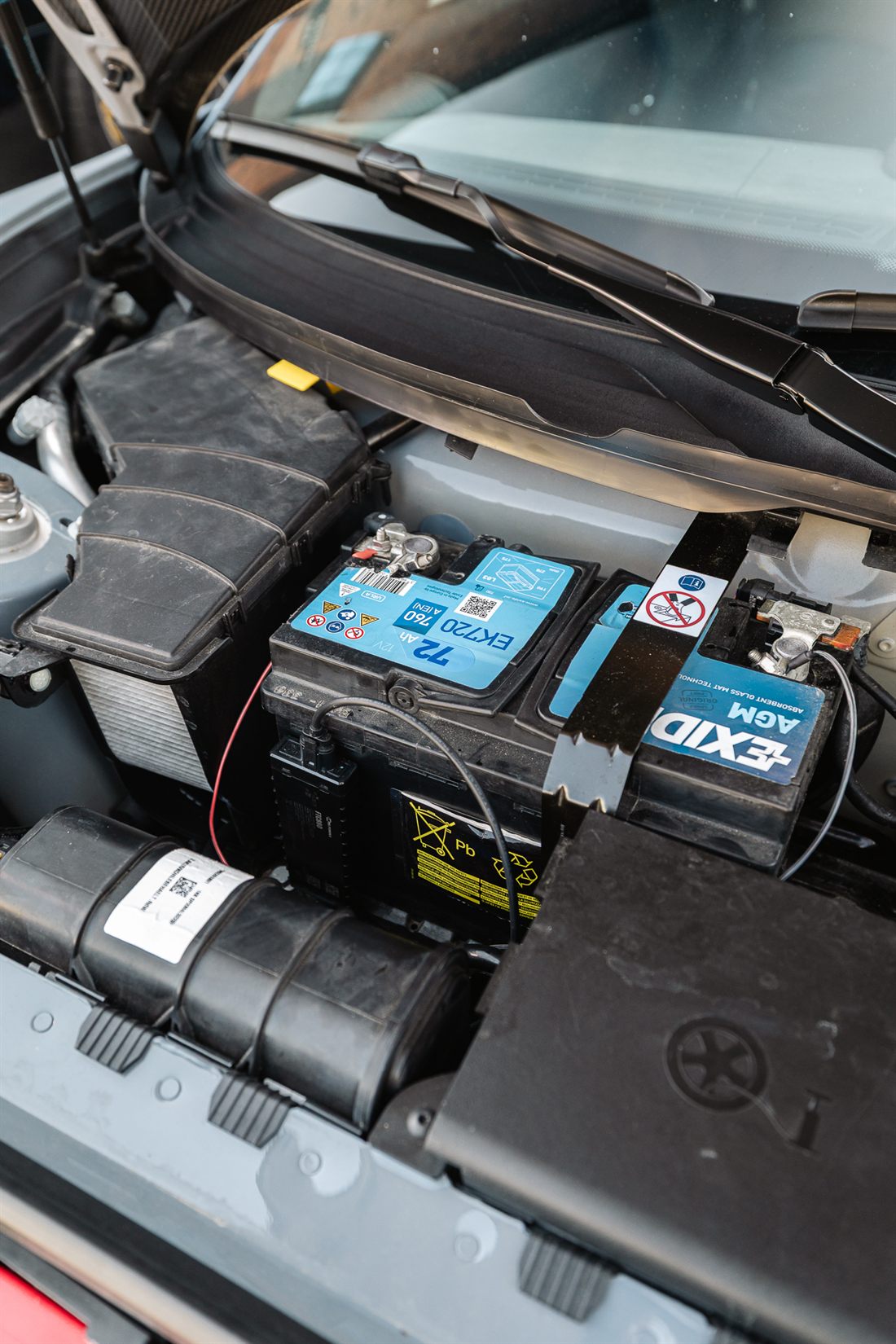
The car stood in a garage for 15 days. The Connect module quietly loaded the 12V battery. QZ caught the risk before it became a no-start at the worst moment. Result: no morning surprise, no tow, no unnecessary stress.
A small device with its own SIM, connected to your 12V battery. It watches around the clock — even while the car sleeps in the garage — and warns you days ahead, before it leaves you stranded. For premium cars, seasonal machines and small fleets.
Get QZ for my car →
According to ADAC, in 2025 the 12V battery caused 45.4 % of all roadside breakdowns. Not the engine. Not the gearbox. Not the electronics. The battery.
QZ is built for exactly this moment.
QZ doesn't fix every possible battery failure. It addresses the most important moment: timely warning before a no-start.
Source: ADAC Pannenstatistik 2025 →A regular voltmeter shows the voltage. QZ watches the battery's behaviour over time and translates it into one simple action. Four states. Nothing more.
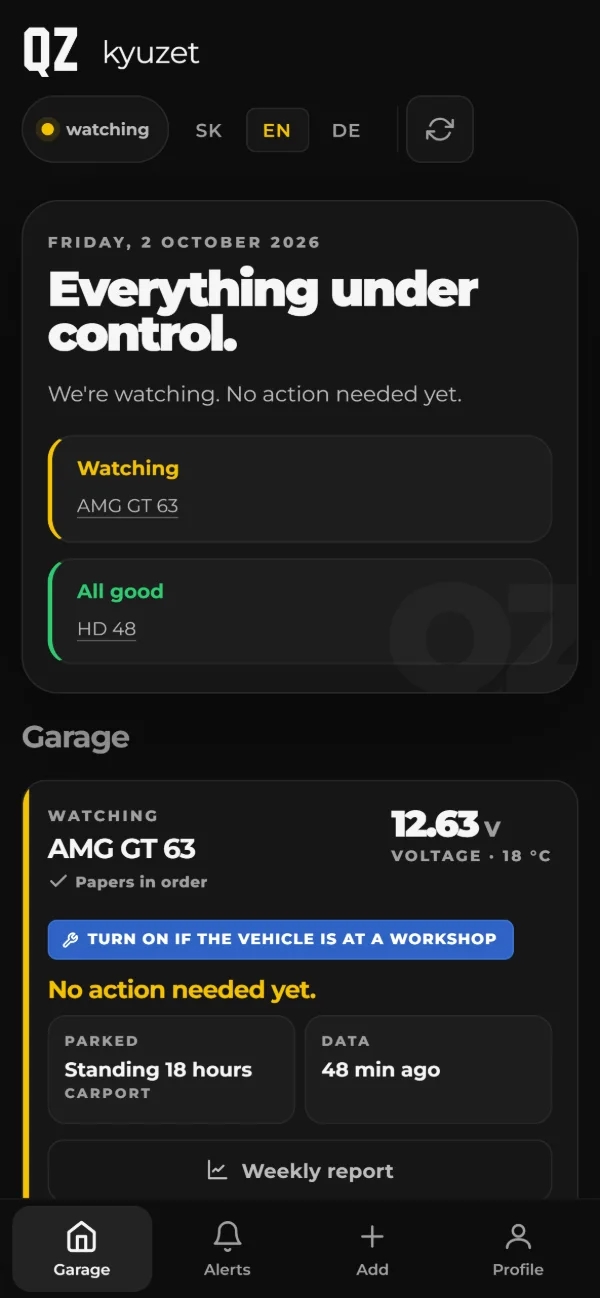
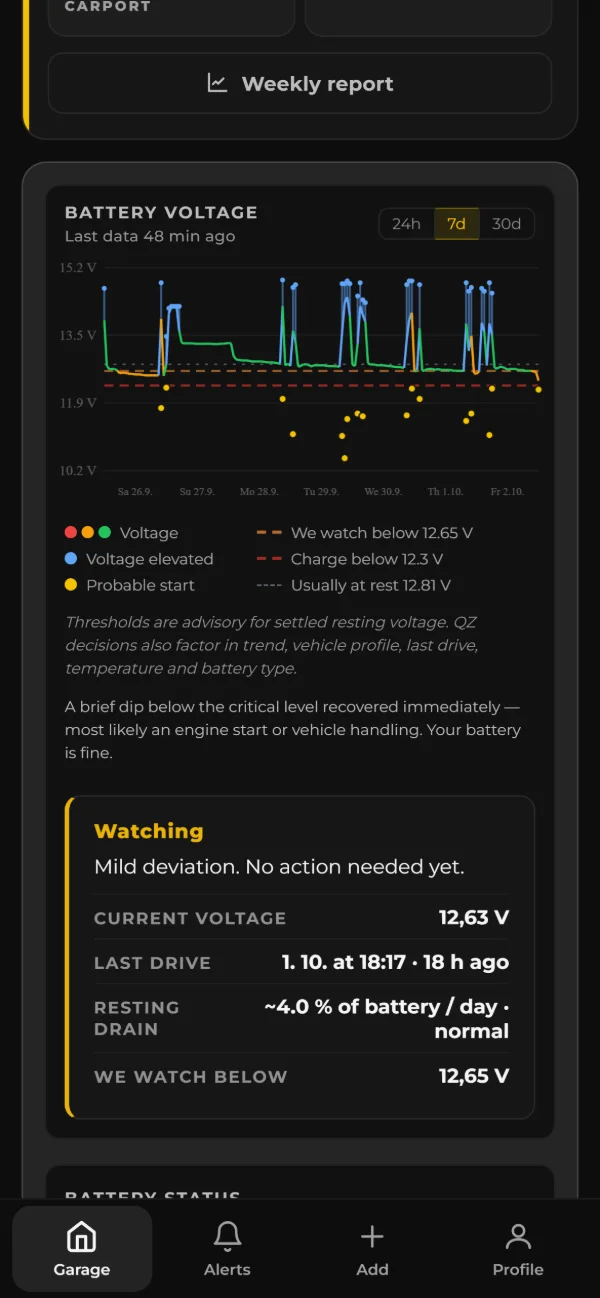
Concretely: instead of "12.35 V", QZ tells you "Battery spent 48 h below its healthy zone — charge today." One number that drives action — not a graph to decode.
One small device connected to your 12V battery. Mobile network included. Web app on your phone. Notifications only when there's something to do.
Connects to the + and − terminals of the 12V battery. Typical install ~10 minutes. 4G LTE included — no separate monthly fee for connectivity. For hard-to-reach batteries we recommend workshop installation.
You get a push only when there's something actionable. No daily spam, no graphs, no FYI updates.
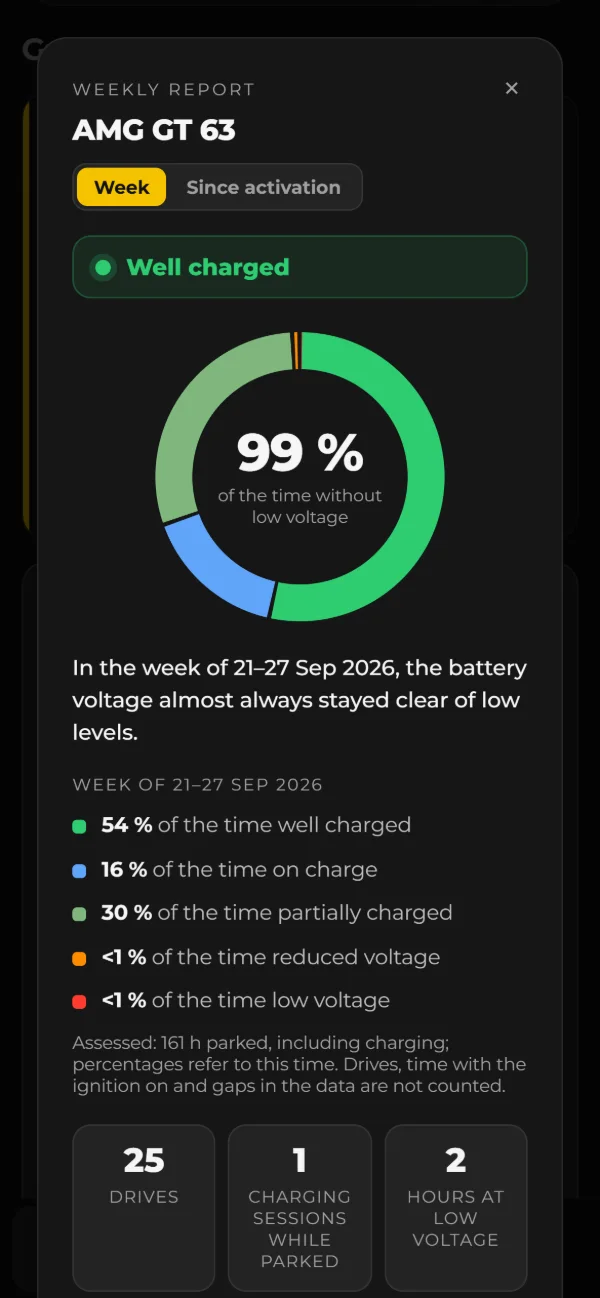
Web app on your phone (no App Store) shows status and a short explanation — no technical jargon.
Activation walks you through step by step. After that, only alerts when there's something to do.
Real recording of the QR activation (26 s). The app runs in English, German and Slovak.

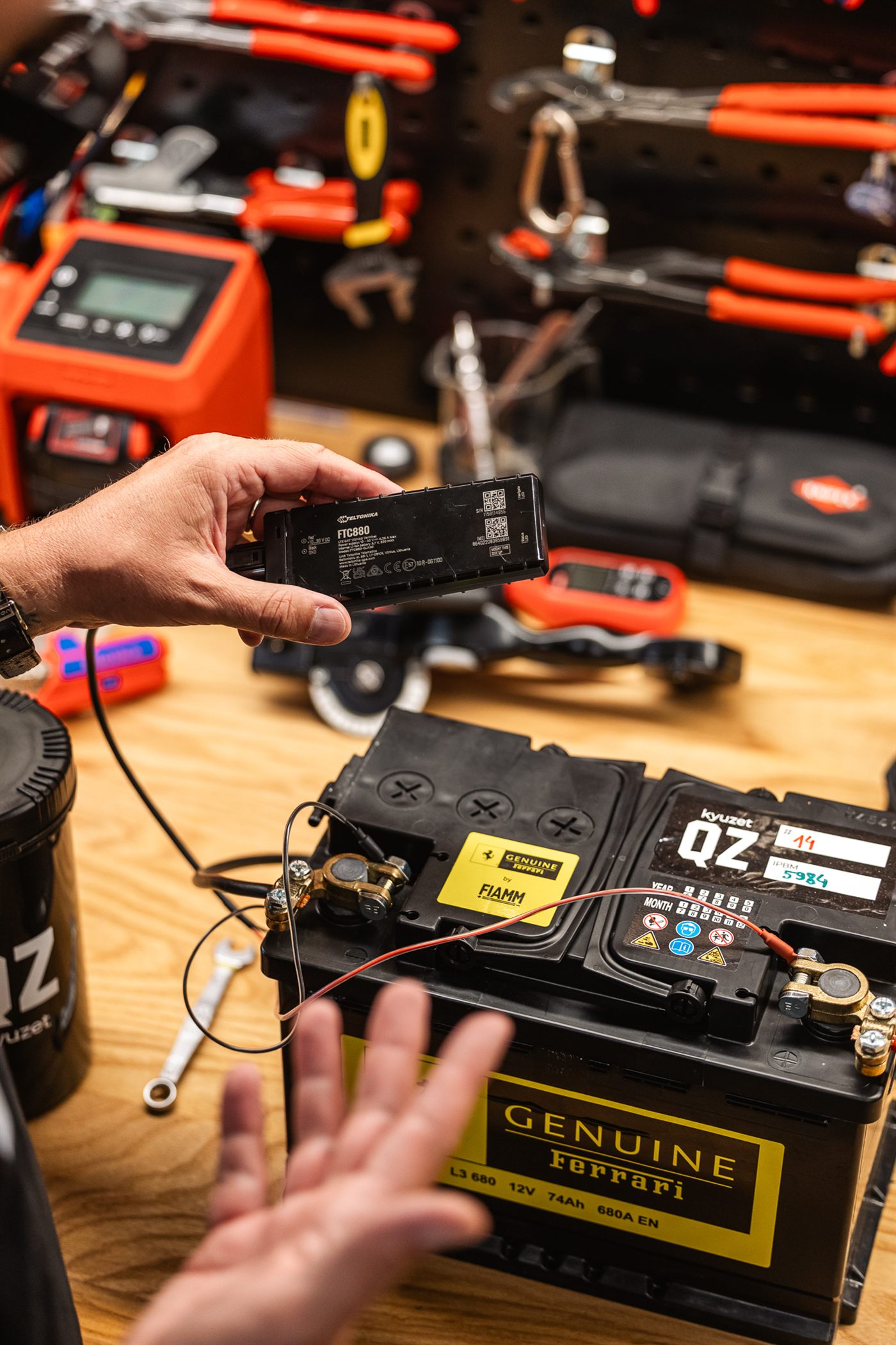
The QZ device before installation — connects to the + and − battery terminals, typically ~10 minutes.
Weekend cars, classics, convertibles, motorcycles and campers. Garaged for weeks — and they must start on the day it counts.
Luxury and performance vehicles that quietly lose voltage while sitting still. Parasitic drain is higher than you think.
Dealerships and showrooms, workshops with courtesy cars, rentals, delivery. Each morning you see which car needs charging — before you hand it to a customer. Online checkout, no sales calls; for 21+ vehicles we start with a pilot.
If you drive 30+ min every day and the battery has never failed — this adds less value for you.
The car stood in a garage for 15 days. The Connect module quietly loaded the 12V battery. QZ caught the risk before it became a no-start at the worst moment. Result: no morning surprise, no tow, no unnecessary stress.
The car stood at the shop with doors open for too long, not on charge. Battery dropped critically low. The mechanic had no idea. QZ warned in time — I called the shop before the battery died completely.
Result: no delay at handover, no jump cables, no apologetic explanation to the customer.
One van doesn't start. Another vehicle is used to jump it. Now both are delayed — and a customer pickup goes south.
QZ should give the fleet manager time to act a day in advance — not deal with chaos at 6 AM.
First sunny day. You want to ride — battery is too low. The day is spent solving the problem instead of driving. QZ tells you a week in advance, while you can still top up calmly.
Single driver, multiple cars, or a small business — buy QZ instantly. Larger fleets start with a pilot.

Up to 20 vehicles: click and pay. Above 20: we start with a pilot to align deployment, billing and accountability.
No pre-order vapor. First-batch devices are being packed and shipped to their first owners — exactly as you see in the clip.
Short dispatch clip, muted.
30 seconds. We'll be honest — even if you don't need QZ.
Indicative. QZ decides from real voltage, time and battery type. Risk sources: ADAC, VARTA, Yuasa.
First, it spends too much time in a state that harms it.
QZ watches that.
A regular voltmeter shows you a number. QZ tracks whether the battery is spending too long in a state that's destroying it. If it is, you get notified in time — while there's still time to act.
When the battery is healthy, a flat car often jump-starts from another one — for free. The problem isn't the few euros. It's that it always happens at the worst moment — before a client, before a flight, at the start of the season.
The car won't start exactly when you need it least. QZ tells you a day ahead, while there's still time to act calmly.
Repeated deep discharge quietly destroys the battery (sulfation) — you pay for a new one sooner. QZ keeps the battery out of the state that shortens its life.
When it goes to the extreme: most flat batteries cost €0 (a jump-start from another car). When a failure ends in replacement — an ordinary car €60–150, a premium car (OEM AGM + battery registration at the workshop) realistically €400–700. For a fleet it adds up per standing day.
QZ isn't about saving a few euros on jumper cables. It's a timely warning so a weak battery doesn't catch you out at the worst moment — and a battery that lasts longer.
Price sources: public pricing of authorised workshops (BMW/Audi/Mercedes SK) 2026, replacement battery prices incl. OEM AGM, standard SK assistance and towing rates 2025. Actual costs depend on model, region and conditions.
You turn the key. No response.
Plans stop. Time runs.
This is the moment QZ detects earlier.
Flooded, EFB, AGM, GEL and LiFePO4 batteries have different risks. QZ distinguishes the battery type and watches what matters for it.
Prolonged time in low state of charge can drive sulfation — hard crystals the battery can no longer break down. Capacity loss is permanent.
QZ watches: hours in the risk zone for each chemistry, discharge rate and temperature compensation.
Different chemistry, different rules. LiFePO4 doesn't sulfate, but is sensitive to deep discharge, BMS cutoff and improper charging. It must not be charged below 0 °C.
QZ watches: low state, BMS protection, suitability of charging cycle.
Sources: VARTA Service Manual, Yuasa VRLA Storage Guide, Battery University BU-806 (sulfation), Power-Sonic LiFePO4 Charging Guide, OPTIMA Batteries specifications.
Every car — combustion, hybrid or full EV — has a 12V battery. And it's the single most common reason an EV ends up stranded.
In EVs the 12V battery is an even bigger share of breakdowns (ADAC callouts) than in combustion cars (~45 %) — though EVs break down less often overall (fewer callouts per 1000 cars). Source: ADAC, EV breakdowns 2024.
In an EV the 12V powers the locks, screens and the relays that even connect the big traction battery. When it drops, the car may not open or "wake" — sometimes not even connect to charge. While parked, sentry and telematics features quietly drain it.
QZ connects to the 12V auxiliary battery's terminals — regardless of powertrain — not the high-voltage traction battery. It measures voltage, knows the chemistry (lead-acid and LiFePO4) and warns before it strands you. Protection against a flat 12V works from day one; deeper EV-specific logic (DC-DC charging patterns) is still being validated on real cars.
QZ is first and foremost a battery guardian. As a bonus, add your inspection, insurance or vignette and QZ notifies you ahead of time as a deadline approaches — a month before and again just before — so nothing slips. Optional, you don't have to use it.
A Maserati GranTurismo Modena sat in its garage, and from the outside everything looked fine. QZ, however, saw the EFB battery's resting voltage drop to 11.94 V — a critical level at which the car would not start in the morning. At 22:53 that evening it alerted the owner, and the charger went on the car that same night.
Read the full story →I love cars and motorcycles — from modern performance models to classics — and I kept running into the same problem: the car was supposed to be ready, and it wasn't. I tried battery monitors, but most of them ended at a Bluetooth app and a number that tells you nothing.
So I built QZ. Behind it is the Slovak company OOZI s.r.o., it runs on Teltonika industrial telematics, and the data stays on servers in the EU, in line with GDPR.
When you write to us, it's not an anonymous system that answers. It's a person who spent years dealing with this exact problem on his own cars.
For larger fleets we need to align deployment, billing and accountability. We set up the pilot on 5 vehicles that sit, drive irregularly or cause morning chaos. After 30 days we evaluate alerts, interventions and real impact.
Morning chaos disappears when you know a day in advance which vehicle will fail.
The customer car in service won't die from a battery. No apologetic handovers.
Demo and stock cars start whenever you need them.
For 1–20 vehicles you don't need to wait for a pilot — buy QZ directly from pricing above (click-and-pay).
When a battery lasts longer it's not just less expense — it's one more battery that never has to be made or re-smelted.
Lead-acid batteries are ~99 % recycled in the EU — but recycling isn't free. Collecting, hauling across Europe, smelting and refining the lead, and safely handling hazardous residues all burn energy and produce emissions. Doubling a battery's life halves that burden.
For fleets, QZ can turn that into a concrete year-end number — how many batteries timely care let you avoid replacing. Input for your ESG report.
At an average ~20 kg battery (~60 % lead), every premature failure is material that didn't need to be made and re-smelted — a "recycling footprint", not landfill waste. Sources: EUROBAT, CORDIS (secondary lead), MDPI lead-acid LCA 2025.
123456789. EU B2B reverse-charge is verified via VIES and applied automatically — no Slovak VAT.A single battery problem often costs more than just the battery: tow, delay, workshop, cancelled plan. For premium cars and fleets the real loss is many times the device price.
Get it for my car →